
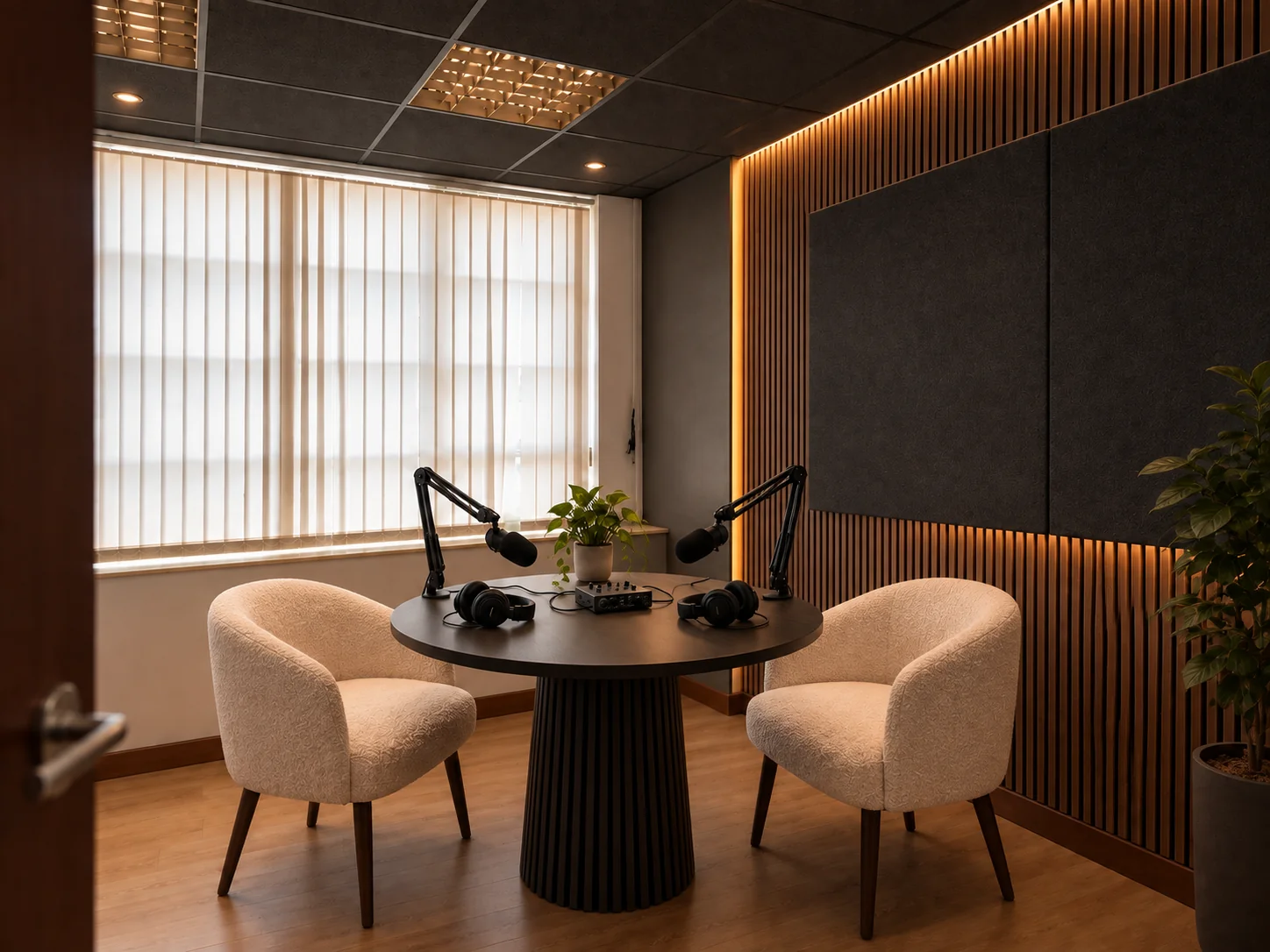
The price of a podcast studio is only useful when you know what the booking is supposed to produce. A forty-minute interview can require preparation, sound checks, pauses, repeated introductions and file handling around the conversation itself. Adding video creates further decisions. This guide helps Leicester hosts and organisations build a realistic session budget, using Studio B at Patmos as a concrete example while keeping room hire separate from production services that need their own agreement.
Studio B at Patmos in Leicester is listed from £40 per hour with a two-hour minimum. Budget for the full production window, including setup, checks, recording and wrap, rather than episode length alone. Review the booking total and confirm any camera, operator, editing or publishing arrangements separately before treating them as included.
Why is episode length different from booked time?
An episode is the edited result a listener or viewer receives. The booking contains the work needed to create that material. Hosts and guests need to settle into the room, the recording arrangement needs checking and someone must verify that usable files are being captured. A conversation may pause for a correction or need an introduction recorded afterwards. Those minutes are part of the production even if none appears in the finished episode, so the schedule should make them visible.
Build the timeline from arrival to departure. Include the first checks, the planned conversation, breaks where needed, any additional short recordings and wrap. Ask the person responsible for recording to review the estimate. A two-hour minimum does not promise a two-hour finished episode or any fixed number of episodes. The useful output depends on the format, preparation and technical workflow. A simple, well-rehearsed conversation may need less preparation than a multi-part video production with changing guests.
What does the Studio B price establish?
The published Studio B terms are from £40 per hour with a two-hour minimum. Its confirmed features include podcast microphones, professional lighting, a camera-ready set and space for up to four speakers. Those details identify the room and its intended use for podcasts, interviews, courses and talking-head video. Review the complete price for the duration you select in the booking flow. Do not assume a longer session's total from an advertised starting rate alone.
A camera-ready set describes the environment; it does not automatically establish camera hire, recording operation, editing or publishing as included services. Specify what your production requires and confirm the arrangement. If you already have a producer or recording operator, ask them to lead the technical questions. If you do not, establish who will perform those tasks before inviting guests. A clear room price is valuable, but it cannot fill an unassigned role in the production plan.
Which costs belong outside the room-hire line?
List the work before, during and after the session. Preparation may involve research and guest coordination. Recording may require an operator and equipment beyond confirmed room provisions. Afterwards, someone may need to select takes, edit, prepare captions or publish the programme. Not every podcast uses all those services, and your own team may handle some, but every required task needs an owner. Keep each confirmed cost or internal responsibility visible rather than assuming the room booking includes the entire episode pipeline.
Match the budget to the formats you actually intend to publish. An audio interview and a video episode with several clips have different workloads. Agree the number and type of outputs before estimating post-production. If the budget is limited, consider launching with a simpler format that the team can complete consistently. Capturing more material is not automatically good value when nobody has the time or resources to turn it into a finished programme that reaches the audience.
Can recording several episodes in one booking save money?
Batching can reduce repeated preparation when episodes share the same hosts, setup and technical arrangement. It works best when each conversation has a clear outline and the team can maintain concentration. Estimate the complete time for every episode and include transitions, checks and breaks. Do not divide the booking by your preferred episode count and assume the result is achievable. A second guest, a change of format or a more demanding subject can alter the rhythm substantially.
Create a stop rule for the session. Define the material that must be completed and the optional recording that can wait if quality or energy declines. Review the first capture before repeating the same workflow across several episodes. One unnoticed problem can otherwise affect the entire batch. Compare the cost of a realistic batch plan with separate bookings, but avoid promising a fixed cost per finished episode until the capture, editing and delivery arrangements are all understood.
How does better preparation protect the budget?
Write an episode promise: what should the audience understand, feel or be able to do after listening? Build a flexible question outline around that promise and share the purpose with guests. Ask them for relevant examples or names in advance, especially where accuracy matters to the discussion. A prepared host can guide the conversation without reading every sentence, while a guest who knows the subject and boundaries is less likely to spend booked time trying to discover the format.
Decide who checks the recording, who watches time and who identifies any essential follow-up question. Agree a simple way to pause and restart if needed. Prepare introductions, names and the closing message, but allow the central discussion to develop naturally. This division of responsibilities prevents the host from trying to manage every technical task while interviewing. Better preparation does not remove all surprises; it gives the team a stable process for handling them without losing the purpose of the episode.
What should you verify before paying for the session?
Confirm the number of speakers, whether the recording is audio-only or includes video, the technical responsibilities and the intended file handover. Studio B supports up to four speakers, but the details of a particular capture setup still need to match the production. Ask about any essential item or service not confirmed on the podcast service page. Keep the answers with the brief and make sure the person operating the session has seen them before the booking day.
Consider how the room fits a wider project. Studio A and Studio B can operate independently together, and Studio B remains independently bookable when The Space is reserved. That does not mean a podcast booking includes access to the main floor or that an event booking includes Studio B. If you want portraits, a workshop and a recorded conversation, plan the products and timing explicitly. Treating each requirement clearly helps keep the budget and availability aligned.
How do you turn the budget into a dependable booking?
Create a concise production plan showing the booked window, episode outline, people, confirmed provisions and separate responsibilities. Give the session a realistic priority: one strong interview, a defined batch or a specific course segment. Check that the budget includes the work needed after recording, not just the room. Where an essential cost is still unknown, resolve it before treating the project as approved. This gives the team a practical definition of success and prevents the scope from growing silently.
Explore the Patmos podcast service and check Studio B for your chosen date and duration. Review the displayed total, confirm any specific technical needs and share the agreed session plan with the host, guests and operator. After recording, assess the usable material and the time needed to finish it. Use that evidence to refine the next budget. A repeatable process that produces complete episodes is a more meaningful measure of affordability than a room rate considered on its own.
Useful answers
Questions about planning your booking
What is Studio B's minimum booking?
Studio B has a two-hour minimum and is listed from £40 per hour. The reserved time should cover setup, checks, recording and wrap. Review the complete amount for your chosen duration in the booking flow.
Does camera-ready mean cameras and editing are included?
No inclusion should be inferred from that description. It describes the set. Confirm any camera, recording operator, editing, file delivery or publishing requirement separately, and assign responsibility for the complete production workflow before the session.
Can I budget by the final episode's running time?
Use final length as one input, not the whole calculation. The booking also contains preparation, checks, pauses and wrap. Estimate those tasks with the person responsible for recording and account separately for the work needed to finish the episode.