
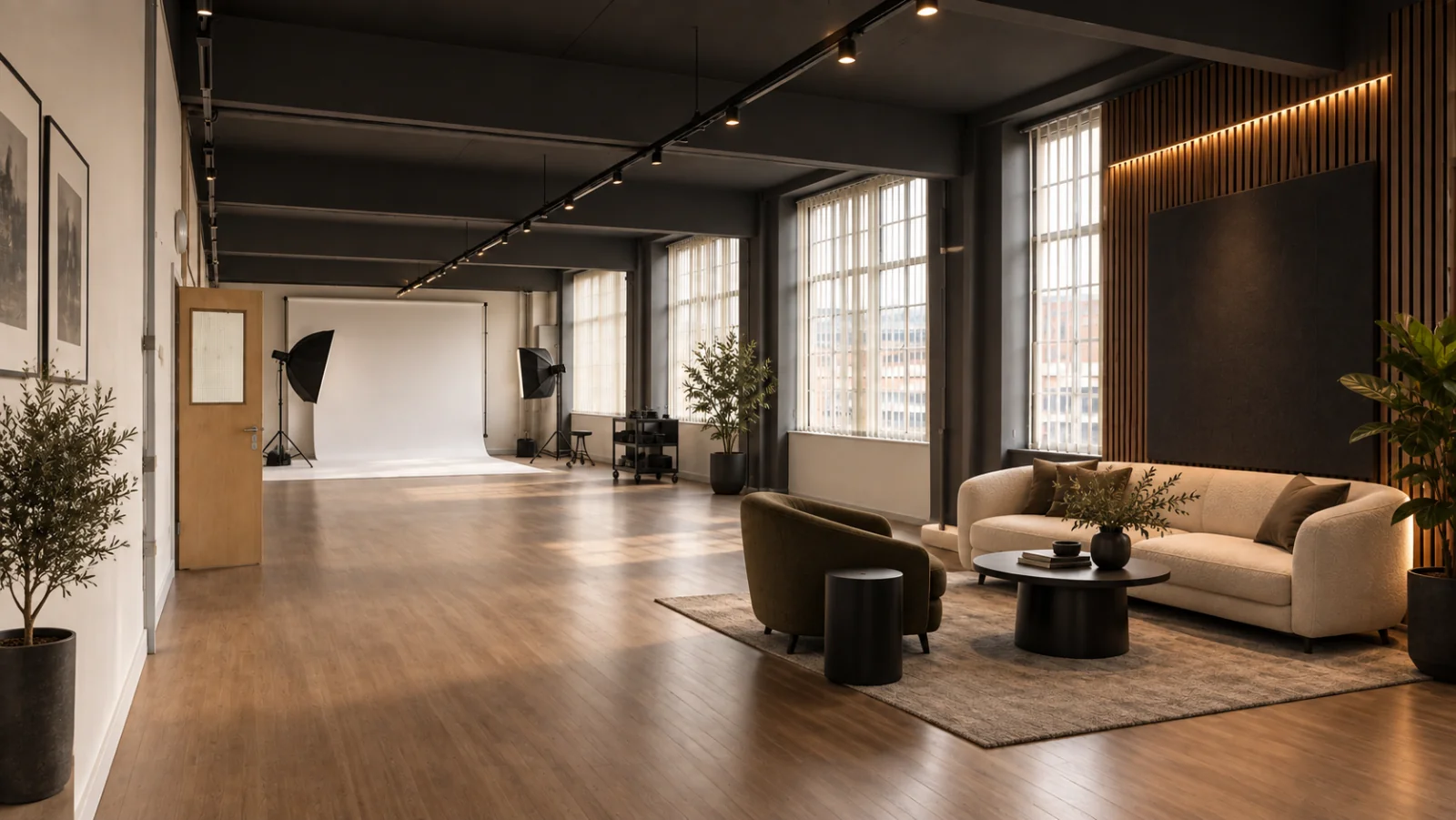
Choosing a creative event or meeting space in Leicester begins with the work people need to do together. A good room cannot rescue an unclear purpose, and an impressive agenda can still struggle if the layout, timings and attendee information do not support it. The most reliable approach is to define the outcome, translate the programme into physical and practical needs, then compare those needs with confirmed venue facts. This guide covers goals, layout, timing, workshop and launch planning, attendee communication and regional access. It also explains The Space at Patmos, a flexible entire studio floor for workshops, launches, gatherings and small meetings, and why the separate Studio B podcast room remains independently bookable.
Define what must be different when the session ends
Start with an outcome that describes a change, not merely an activity. A planning meeting may need a prioritised decision and named owners. A workshop may need participants to practise a method and leave with a draft. A launch may need guests to understand a product, meet the people behind it and know what to do next. A community gathering may value connection, but the organiser should still define how the programme will help that connection happen.
Write the outcome in language that can be checked. Instead of saying that the event should be engaging, specify the contribution you want from attendees and the material they should leave with. This shapes the agenda and helps you decide whether the room needs one shared focus, several working groups or a sequence of different modes. It also prevents extra content being added simply because a speaker or activity is available.
Identify who owns the final call during planning and on the day. Questions about timing, layout or programme changes should not circulate among several organisers while participants wait. The decision-maker needs a complete view of the goal, attendee expectations and booking limits. They can invite specialist advice, but responsibility should remain clear.
Match the layout to each part of the agenda
List the behaviours in the programme: listening, discussing, writing, making, presenting, moving between groups or viewing a focal item. Each behaviour places different demands on the floor. A presentation-led opening needs clear attention in one direction. A working session needs surfaces and comfortable interaction. A launch may need a welcome area, a focal moment and space for conversation. Design the layout around those behaviours rather than copying a standard meeting-room arrangement.
The Space at Patmos is the entire flexible studio floor with a flexible floor layout. That flexibility is useful when the programme has more than one mode, but every change takes time and needs an owner. Decide whether the layout can support the whole session with small adjustments or whether a deliberate reset is essential. If furniture or materials must move, put the change in the agenda and assign people to complete it safely and calmly.
Sketch the proposed layout before the event. Mark the main activity areas, the organiser position, any materials and the routes people are likely to take between stages. The sketch does not need architectural precision; its purpose is to expose conflicts. If two activities depend on the same area or a reset leaves no time for the next facilitator, revise the plan before the booking begins.
Build timing from participant experience, not content alone
An agenda often counts only formal content. The booking must also include organiser arrival, preparation, attendee welcome, transitions, breaks, questions, a proper close and the final wrap. A ninety-minute workshop may sit inside a much longer operational window. Work from the full attendee journey and then add the setup and close-down stages that participants do not see.
Use fewer, purposeful segments rather than a crowded sequence. People need time to understand a prompt, contribute and hear what happened in other groups. A launch needs room for arrivals and conversation around the main announcement. A small meeting needs enough space after discussion to make and record decisions. Protect the end of each segment from the next one so the organiser is not constantly asking people to stop just as useful work begins.
The Space has a four-hour minimum booking and is listed from £300. Compare that confirmed minimum with the complete operational schedule, not only the advertised programme. If the plan fills every available minute, remove or simplify something before adding time pressure to the day. A clear, achievable agenda usually creates a stronger experience than a longer list of unfinished activities.
Design a workshop around participation and outputs
For a workshop, decide what participants will produce or practise. That output could be a prototype, a plan, a set of ideas, a rehearsal or a shared decision. Explain it at the beginning so participants understand why each activity matters. If the workshop includes instruction, keep it proportionate to the time available for application. People often remember what they actively worked through more clearly than a long sequence of slides.
Prepare instructions that can be understood without repeated private explanation. State the task, time, group arrangement and expected output. Test the activity with someone who was not involved in designing it. Their questions will reveal hidden assumptions. Bring only the materials the agenda actually uses, grouped and labelled by stage so the facilitator is not sorting supplies while participants wait.
Plan how group work returns to the whole room. Asking every group to report everything can consume the final part of the session without producing synthesis. Instead, request one decision, insight or unresolved question from each group, then connect those contributions to the stated outcome. Record next actions visibly and assign owners before the close.
- Name the practical output or behaviour participants will complete.
- Test instructions with someone outside the planning team.
- Organise materials in the order the agenda uses them.
- Reserve time to synthesise group work and assign next actions.
Plan a launch around one clear focal moment
A launch can include welcome, conversation, explanation, demonstration and a next step, but it still needs a central moment. Decide what is being revealed or understood and who should lead that moment. Build the rest of the programme to help guests arrive ready for it and remain long enough to respond. If several announcements compete for attention, separate the essential message from supporting details.
Think through what guests can see and understand from where they will be during the focal moment. If a physical object, demonstration or speaker matters, test the planned position and avoid blocking it with unnecessary elements. If the launch includes content capture, identify the shots or short segments required and coordinate them with the live programme. The event should not unexpectedly turn attendees into a production crew or make them repeat spontaneous reactions.
Make the next action specific and appropriate. Guests may need to explore a product, join a conversation, receive follow-up information or meet a particular person. Tell them what is possible without turning the close into a long sales script. Assign team members to answer questions and capture agreed follow-ups so interest is not lost after the formal moment.
Give small meetings enough structure to make decisions
A creative setting does not mean an unstructured meeting. Send the purpose, preparation and decision questions in advance. At the start, confirm what is in scope and what will be recorded for later. If the topic is exploratory, define how ideas will be selected or carried forward. If the topic is a decision, state who decides and what evidence they need.
Use the flexible floor to support the work. A team might begin together, separate into focused groups and return for synthesis. A facilitator can place questions or work-in-progress material where the group can engage with it. Every movement should have a reason connected to the agenda; changing position simply to create energy can consume time without improving the decision.
Finish by reading back decisions, owners and dates. Distinguish an action from a general intention, and record unresolved questions with a named route to resolution. Share the notes promptly in a format that people can use. The measure of a productive meeting is not how animated the conversation felt in the room, but whether the right work continues afterwards.
Communicate the attendee journey clearly
Attendee information should answer what the session is, why the person is invited, when they should arrive, what they should prepare and who to contact on the day. Send the confirmed Leicester location details from one reliable source and update everyone if the plan changes. Avoid copying fragments of old invitations when the timing or purpose has moved.
State the planned start and finish, including whether arrival time is earlier than the first formal segment. Tell participants if the session includes active workshop tasks, recorded content or materials they need to bring. Ask about relevant access requirements early enough to seek accurate information for the booking. Do not make broad claims about accessibility or other facilities without confirmation.
For facilitators, speakers and suppliers, provide a more detailed call sheet with responsibilities and setup order. Include the organiser decision-maker and a day-of contact. Keep attendee-facing communication simple while ensuring the delivery team has enough operational detail. Different audiences need different documents, but the dates, times and purpose must agree across all of them.
- Purpose, invitation context and expected contribution.
- Confirmed arrival, start and finish information.
- Preparation, clothing or materials relevant to the activity.
- Named contact and a route for specific access questions.
Coordinate Leicester and regional access planning
Leicester is the central reference point for the booking, but attendees may be travelling from across the East Midlands, including Loughborough, Nottingham, Derby and Coventry. Ask people to check their own route using current information and send an acknowledgement of the call time. Do not promise a fixed travel duration: routes and conditions vary, and a generic estimate can become misleading.
If the programme depends on a facilitator, speaker or item arriving from another city, make that dependency explicit. Consider whether another agenda element can begin if they are delayed, and keep the organiser contact available for updates. Bring materials with the delivery team where possible rather than relying on an attendee who does not know the setup sequence.
Share only confirmed venue and arrival details. This guide does not claim parking, a street address, specific transport links or unsupported facilities. Ask Patmos about requirements that matter to the particular group before finalising the event plan. Accurate answers to specific questions are more useful than assumptions presented as universal venue facts.
Understand how The Space relates to Studio A and Studio B
The Space is the entire flexible studio floor for workshops, launches, gatherings and small meetings. Because it uses the event floor, a booking for The Space blocks Studio A. Organisers should therefore treat The Space as the event or meeting product rather than assuming Studio A remains a separate add-on during the same period.
Studio B is a separate podcast room and remains independently bookable while The Space is reserved. That independence is a clear operational distinction: another customer may be using Studio B at the same time. Plan The Space programme around the area included in its own booking, and do not assume that the podcast room is part of the event package or available as overflow.
The separation can also help teams compare products honestly. Choose Studio B when the primary work is a podcast, interview, course or talking-head video for up to four speakers. Choose The Space when the primary work is a workshop, launch, gathering or small meeting that benefits from the flexible studio floor. Matching the product to the core activity is more reliable than choosing by name alone.
Use a final organiser checklist and book The Space
Before confirming the event, review the outcome, participant list, full booking window, layout sketch and responsibilities. Check that the agenda contains setup, welcome, transitions, breaks, close and wrap. Confirm what materials the organiser must bring and which venue questions still need an answer. If any requirement is essential, resolve it explicitly rather than assuming it follows from the words creative space or meeting space.
On the day, orient the delivery team before attendees arrive and walk through the first transition. Keep the agenda, contact list and decision log with the organiser. During the session, protect the main outcome and adapt optional elements first if timing changes. Before leaving, collect the agreed materials, record follow-ups and complete the wrap within the booking.
When the plan is ready, review the relevant service pages for creative space, meeting room or corporate event space hire in Leicester. Then use The Space booking flow to check availability and choose a duration that covers the complete organiser and attendee journey, from setup through final wrap.
Useful answers
Questions about planning your booking
What is The Space at Patmos suited to?
The Space is the entire flexible studio floor for workshops, launches, gatherings and small meetings. Its floor layout can be planned around the activity, subject to the confirmed scope of the booking.
How long is the minimum booking for The Space?
The Space has a four-hour minimum booking and is listed from £300. Build the duration from the complete schedule, including organiser setup, attendee arrival, transitions, the programme, closing and wrap.
Is Studio B included when The Space is booked?
No. Studio B is a separate podcast room and remains independently bookable when The Space is reserved. Plan the event within The Space and do not assume Studio B is included or available as overflow.
Can Studio A be booked at the same time as The Space?
No. The Space uses the event floor and blocks Studio A for the same period. Studio B remains the independent room.